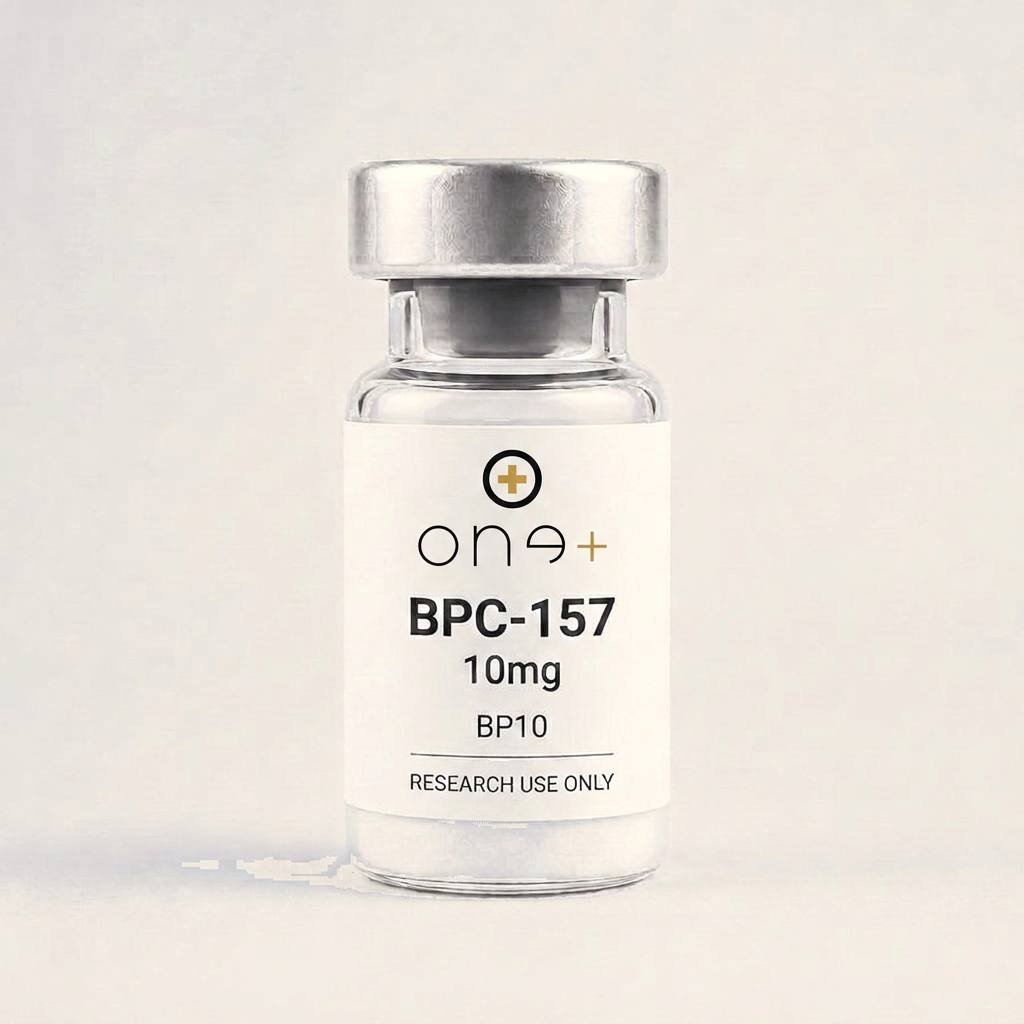
BPC-157 research reference
BPC-157 is a synthetic pentadecapeptide derived from a partial sequence of body protection compound, a protein isolated from gastric juice. It is one of the most frequently referenced peptides in preclinical tissue-repair literature, where it is studied in models of angiogenesis, tendon and ligament healing, and gastrointestinal mucosal integrity. One Plus supplies BPC-157 10mg as a lyophilised powder for in vitro and laboratory research use only.
Research context
Published preclinical work on BPC-157 concentrates on three broad areas. The first is soft-tissue repair: rodent models of tendon, ligament, and muscle injury have been used to examine changes in fibroblast migration, collagen organisation, and outgrowth rate in cultured tendon explants. The second is vascular signalling, where the peptide has been investigated in relation to the VEGFR2–Akt–eNOS pathway and the formation of new capillary networks around a wound bed. The third is gastrointestinal research, reflecting the peptide's origin, with studies examining mucosal integrity and lesion models in the stomach and intestine.
A smaller body of work examines nervous-system endpoints — nerve transection models, neurotransmitter systems, and blood–brain barrier observations — and interactions with the nitric oxide system. Findings across this literature are almost entirely from animal and cell-culture models; there is no established clinical evidence base, and results should not be extrapolated beyond the research setting.
- Angiogenesis and endothelial signalling models
- Tendon, ligament, and muscle fibroblast studies
- Gastrointestinal mucosal integrity research
- Cytokine and inflammatory-pathway modulation
Specification and COA evidence
Every One Plus batch of BPC-157 is manufactured by solid-phase peptide synthesis and released against a third-party certificate of analysis. Identity is confirmed by mass spectrometry against the expected monoisotopic mass of 1419.5 Da, and purity is determined by reverse-phase HPLC with a release threshold of 99% or greater; the current batch (BP10) assays at 99.6%. The COA also reports appearance, water content, and net peptide content so a laboratory can calculate accurate working concentrations rather than assuming label mass.
COAs are batch-specific. Request the document for the batch code printed on your vial rather than relying on a generic example, and retain it alongside your experimental records.
- Purity: 99.6% by RP-HPLC
- Molecular mass: 1419.5 Da (confirmed by MS)
- Format: 10mg lyophilised powder, sealed vial
- Batch code: BP10 — COA available on request
Storage and reconstitution
Lyophilised BPC-157 is stable for extended periods when kept sealed, dry, and away from light. Store unopened vials at -20°C for long-term holding, or at 2–8°C for short working periods, and allow a vial to equilibrate to room temperature before breaking the seal so that condensation does not enter the powder.
Reconstitute with bacteriostatic water directed against the vial wall rather than onto the powder cake, then swirl gently until fully dissolved — do not shake or vortex, as mechanical shear can degrade the peptide. As a worked example, adding 2ml of bacteriostatic water to a 10mg vial yields a 5mg/ml solution. Once in solution, keep the vial refrigerated at 2–8°C, protect it from light, and avoid repeated freeze–thaw cycles; aliquot instead if the material will be used across multiple sessions.
- Lyophilised: -20°C long term, 2–8°C short term
- Reconstituted: 2–8°C, protected from light
- Diluent: bacteriostatic water (0.9% benzyl alcohol)
- Avoid vortexing and repeated freeze–thaw cycles
Handling and compliance
BPC-157 supplied by One Plus is intended for in vitro and laboratory research only. It is not a drug, food, or cosmetic; it is not for human or veterinary use, not for use in diagnostic procedures, and has not been evaluated by the U.S. Food and Drug Administration. Purchasers confirm at checkout that they are qualified researchers acquiring material for laboratory use.
Handle in a controlled laboratory environment with appropriate personal protective equipment, and dispose of unused material and consumables according to your institution's waste procedures.
BPC-157 FAQ
What is BPC-157?
BPC-157 is a synthetic 15-amino-acid peptide derived from a sequence found in gastric juice protein. It is studied in preclinical models of tissue repair, angiogenesis, and gastrointestinal integrity, and is supplied for laboratory research use only.
What purity is One Plus BPC-157?
The current batch assays at 99.6% purity by reverse-phase HPLC, with identity confirmed by mass spectrometry at 1419.5 Da. A batch-specific third-party certificate of analysis is available on request.
How should BPC-157 be stored?
Store the lyophilised powder sealed at -20°C for long-term storage or 2–8°C for short working periods, protected from light. After reconstitution, keep the solution at 2–8°C and avoid repeated freeze–thaw cycles.
How is BPC-157 reconstituted?
Add bacteriostatic water slowly against the vial wall and swirl gently until dissolved — do not shake. Adding 2ml of bacteriostatic water to a 10mg vial produces a 5mg/ml research solution.
How long is reconstituted BPC-157 stable?
Stability depends on concentration, diluent, and handling. As general laboratory practice, refrigerated reconstituted peptide solutions are used within a few weeks, kept cold and dark, with aliquoting preferred over repeated freeze–thaw cycles.
Is BPC-157 approved for human use?
No. BPC-157 is sold strictly for in vitro and laboratory research. It is not for human or veterinary use, not for use in diagnostic procedures, and has not been evaluated by the U.S. Food and Drug Administration.
Does One Plus ship BPC-157 with a COA?
Yes. Every batch is released against a third-party certificate of analysis reporting HPLC purity, mass-spectrometry identity, appearance, and net peptide content. Reference the batch code on your vial when requesting the document.