HPLC Method Validation for Peptides
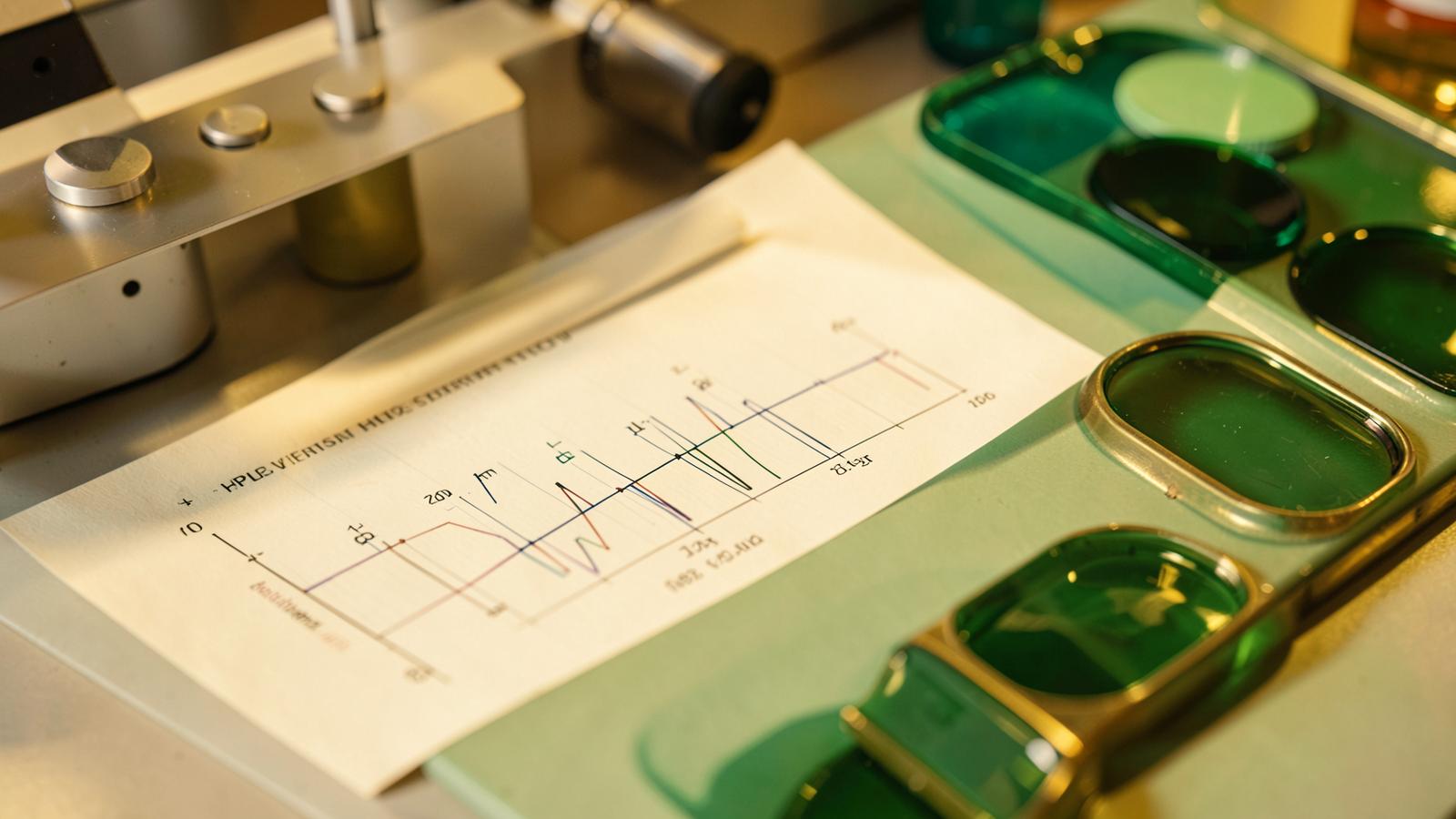
Explore the critical relevance of HPLC method validation in modern peptide research. Learn about specificity, linearity, robustness, and best practices…
Research Use Only (RUO). All compounds described here are supplied strictly for in-vitro laboratory research. Not for human or veterinary use, and not evaluated by the FDA.
The Critical Relevance of HPLC Method Validation in Modern Peptide Research
In biochemical analysis, the precise characterization of peptides is one of the most demanding tasks. As peptides serve as essential tools in in vitro research, the reliability of analytical data is of fundamental importance for the reproducibility of scientific results. High-Performance Liquid Chromatography (HPLC), particularly in reversed-phase mode (RP-HPLC), has become the gold standard for verifying the purity and identity of synthetic peptides. Robust method validation is not merely a formal step, but the foundation for the integrity of the entire experimental series.
When laboratories work with high-purity substances like BPC 157 10MG or EPITHALON 50MG, the analytical procedures must be capable of reliably detecting even the slightest impurities or degradation products. The complexity of peptide structure – due to varying hydrophobicity, charge states, and a tendency to aggregate – requires specifically validated protocols. Without systematic validation according to international standards (such as ICH Q2 R1), experimental data remain vulnerable, and comparability between different research institutions is not guaranteed.
Theoretical Foundations and Separation Mechanisms for Peptides
The separation of peptides by HPLC is primarily based on hydrophobic interactions between the amino acid side chains and the stationary phase of the column. As Aguilar emphasizes in his work on method development, the choice of the correct column chemistry is crucial for the resolution of complex peptide mixtures [1]. Typically, C18 or C8 columns are used, with the pore size (often 120 Å to 300 Å) needing to be matched to the molecular size of the target peptide.
A central aspect of peptide quality control is the optimization of the mobile phase. Usually, a binary gradient system is employed, consisting of water with an ion-pairing reagent like trifluoroacetic acid (TFA) and acetonitrile. TFA not only adjusts the pH but also masks free silanol groups on the stationary phase, significantly improving peak shape. For research on RUO peptides for research purposes, this precision is essential to ensure that observed biological effects in cell cultures can indeed be attributed to the target molecule.
Parameters of Method Validation: Specificity and Selectivity
Specificity is the ability of a method to unequivocally determine the analyte in the presence of impurities, degradation products, or matrix components. In peptide synthesis, residues of protecting groups or erroneous sequences (deletions) can occur, which are chemically very similar to the target peptide. For the analysis of GHK CU 50MG, for example, the method must be able to differentiate the free peptide from the copper complex and any synthesis by-products.
To confirm selectivity, stress studies (forced degradation) are often performed. Here, the peptide is exposed to extreme pH values, oxidation, or thermal stress to demonstrate that the HPLC method can separate the resulting degradation products from the main peak. Additionally, coupling HPLC with mass spectrometry (LC-MS) provides indispensable data for identity confirmation. Aebersold and Mann have shown how mass spectrometry has revolutionized sequence confirmation and the detection of post-translational modifications [2]. This synergy of chromatographic separation and mass spectrometric detection forms the backbone for modern peptides for laboratory research.
Linearity, Precision, and Detection Limits
A validated method must yield linear results over a defined concentration range. This is achieved by creating calibration curves, whose correlation coefficient ($R^2$) should ideally be $> 0.999$. For the quantitative determination of peptides in basic research, this is crucial for monitoring sample stability over time.
Precision is examined at two levels: repeatability (intra-day precision) and intermediate precision (inter-day precision). This involves performing multiple injections of the same sample concentration and calculating the relative standard deviation (RSD) of the peak areas. In the analysis of EPITHALON 50MG, an RSD of less than 1.0% is aimed for to ensure high methodological reliability. In parallel, the limit of detection (LOD) and the limit of quantification (LOQ) must be statistically determined, based on the signal-to-noise ratio (S/N), to define the sensitivity of the method for trace impurities.
Robustness and System Suitability Tests (SST)
The robustness of an HPLC method describes its capacity to remain stable against small, deliberate variations in parameters (e.g., flow rate, column temperature, pH of the mobile phase). A robust process ensures that minor fluctuations in daily laboratory work do not lead to erroneous results. This is particularly important when methods are transferred between different laboratories.
Before each analytical series, a System Suitability Test (SST) is mandatory. This involves checking parameters such as the theoretical plate count (a measure of column efficiency), the tailing factor (peak symmetry), and the resolution between critical peak pairs. Only when these criteria are met can the actual measurement of research samples, such as a purity check of BPC 157 10MG, be performed. These strict protocols are an integral part of excellent laboratory practice.
Best Practices for HPLC Analysis of Peptides
In practical laboratory application, certain procedures have proven effective in extending the lifespan of separation columns and maximizing data quality:
1. Sample Preparation: Peptides tend to adsorb to plastic surfaces. The use of low-binding vials is therefore strongly recommended to avoid concentration losses. 2. Filtration: All mobile phases and sample solutions should be filtered through 0.22 µm membrane filters to remove particles that could clog capillaries. 3. Temperature Control: Peptide separation is highly temperature-dependent. A constant column temperature (e.g., 30 °C or 40 °C) significantly improves the reproducibility of retention times. 4. Column Cleaning: After an analytical series of hydrophobic peptides, the column should be flushed with a high organic content to minimize carry-over effects for subsequent measurements.
These steps are essential when the highest standards are to be maintained within the framework of peptide quality control. The documentation of every deviation and the regular calibration of the HPLC system are further pillars of quality assurance.
Conclusion and Outlook
HPLC method validation is a dynamic and continuous process that goes far beyond the mere execution of standard protocols. It requires a deep understanding of the chemical properties of the respective peptide as well as the physicochemical processes on the stationary phase. By integrating modern detection technologies and strictly adhering to validation parameters, it is ensured that research on peptides like GHK CU 50MG stands on a solid analytical foundation.
Future developments, such as Ultra-High-Performance Liquid Chromatography (UHPLC), enable even faster separations with higher resolution and lower solvent consumption. Nevertheless, validation remains the decisive element to bridge the gap between technological innovation and scientific evidence. For academic and industrial research, precise analytics remains the key to deciphering complex biochemical interactions.
Scientific Disclaimer: The substances described in this article (e.g., BPC 157, Epithalon, GHK-Cu) are intended exclusively for research purposes in a controlled laboratory environment (Research Use Only - RUO). They are not intended for diagnostic or therapeutic use in humans or animals. Any form of clinical application is prohibited. The information provided is based on current scientific literature and serves for the methodological training of specialists in analytics.
Related articles
Deepen your RUO knowledge with curated follow-up reading.
Third Party Testing Pros and Cons
Learn about the importance of third-party testing (HPLC/MS) for high-purity peptides (>99%). Ensure accurate research with One Plus Labs's lab-tested RUO…
Endotoxin Testing in Lyophilised Peptides
Learn why endotoxin tests are crucial for peptide research. One Plus Labs offers >99% purity, HPLC-verified, and US shipping for reliable results.
Stability Studies for Lyophilized Peptides
Lab-tested peptides with >99% purity. Learn about stability studies, HPLC analytics & secure US shipping for your research. Get informed now!